This is funny stuff!!
Joke: Emerging 'isms' of the new economy
INFOSYSism
You have a 1000 poor cows. You put them on a nice campus, & send them one at a time to the US for milking.
PATNIism
You have 10 cows. You make them work so that they give milk of 100 cows.
WIPROism
GE has a cow. You take 49% of the milk.
DELLism
Intel has a Goat. Samsung has a Camel. Buy milk from both & sell it as Cow's milk.
IBMism
You have old stubborn cows. You sell them as pet dogs to innocent small businessmen.
MICROSOFTism
You have a cow. Force the world to buy milk from you. Spend a million dollars to feed poorer cows.
SUNism
You have a bull. It doesn't give milk. You hate Microsoft.
ORACLEism
You have a cow. You don't know which side to milk, so you sell tools to help milk cows.
SAPism
You don't have a cow You sell milking solutions for cows implemented by milking consultants.
APPLEism
You have a cow. You sell iMilk.
SONYism
You have a cow. You spend $50 mn to develop the world's thinnest milk.
CITIBANKism
Welcome to Citibank. If you have a cow, press 1. If you have a bull, press 2...stay on line if you'd like our customer care to milk it for you.
HPism
You don't know if what you have is a cow. You sell complete milking solutions through authorised resellers only.
GEism
You have a donkey. People think you have a 100-year old cow. If someone finds out, that's his imagination at work.
RELIANCEism
You don't yet have a cow. You sell empty cans to people for Rs. 501, because Dhirubhai wanted everyone to have milk.
TATAism
You have a very old cow. You re-brand it as TATA Indicow.
Monday, February 26, 2007


Saturday, February 10, 2007
Apologies
Dear All,
My apologies for having neglected this blog. I will once again be back to blogging very soon.
Apologies once again :-D
Regards,
Prasanna
My apologies for having neglected this blog. I will once again be back to blogging very soon.
Apologies once again :-D
Regards,
Prasanna
Thursday, November 30, 2006

Tuesday, November 28, 2006
My photoplay 1
Astute readers of this blog, the few that there are, would have noticed that I have tried my hand at screenplays. Not having met with success as much as I would like, I have decided to take one step back and see how an attempt at a photoplay goes. Thanks to the email sent by Sujata Kovalam. However, the reconstruction is my effort alone.
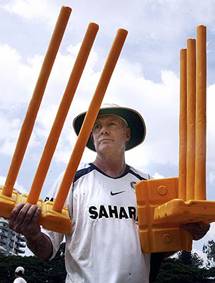
This photo play is set to the hit song from Kaho Naa Pyaar Hai, "Aye mere dil tu gaayejaa", and may be reflective of the current Indian team's performance in South Africa. Indeed, that is what the photoplay suggests. So therefore without further ado...

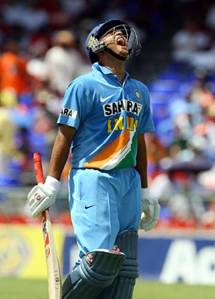

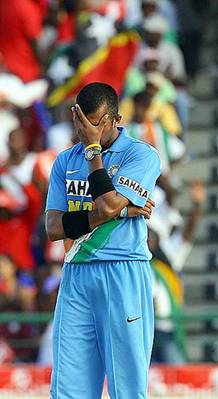


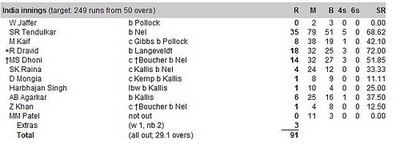
This photo play is set to the hit song from Kaho Naa Pyaar Hai, "Aye mere dil tu gaayejaa", and may be reflective of the current Indian team's performance in South Africa. Indeed, that is what the photoplay suggests. So therefore without further ado...
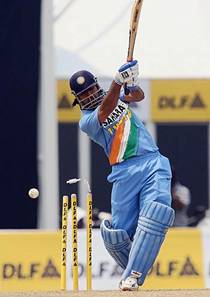
Ek Paal Ka Jeena

Phir To Hain Jaana
Tohfa Kya Leke Jaayie

Dil Yeh Bataana

Khali Haath Aaye The Hum

Khali Haath Jayenge

Bus Pyar Ke Do Meethen Bol Jhilmilayenge

To Hans Kyon Ki Duniya Ko Hain Hasana

Ae Mere Dil Tu Gaye Ja

Ae Aaye Aao Aaye Aa
Sorry for the long delay
Sorry to all the (few) people that read my blog, for a long delay in posting. I had exams for the past month, and hence haven't been able to post regularly. However, as a method of repentence, here is a little something, sent to me by both Sudha and Sudheendra (Sunny), no relation to each other, despite having a 'Sudh' followed by a vowel, hehehe!!! (Sorry for my bad attempt at a joke)
See below...........
See below...........
ATTENTION
ALIENS ARE COMING TO ABDUCT ALL
THE GOOD LOOKING AND SEXY PEOPLE.
YOU WILL BE SAFE,
I'M JUST EMAILING TO SAY GOODBYE
ALIENS ARE COMING TO ABDUCT ALL
THE GOOD LOOKING AND SEXY PEOPLE.
YOU WILL BE SAFE,
I'M JUST EMAILING TO SAY GOODBYE
Friday, October 27, 2006
Aaya India
Notwithstanding India's failure in the Champions Trophy (from what I read in the press), the video below is still good. Maybe Team India should have a look and see the hopes we have for them!!!
GO INDIA!!! OOH AAH INDIA AAYA INDIA!!!!!!!!!!
(I will have a decent blog entry soon, just don't know when though)
GO INDIA!!! OOH AAH INDIA AAYA INDIA!!!!!!!!!!
(I will have a decent blog entry soon, just don't know when though)
Friday, October 13, 2006
My screenplay 2
My screenplay for the Mangal Ho (Aatma) song, from MPTR
Tannn tannn....
Sabne suna re...
Show Wayville Pavilion
Danka bole dhum dhum,
Ramping shot of Ridley Centre front
Jago jago ab tum,
Ramping shot of Ridley Centre right side
Neend me ho kyu tum, oooo...
Cut to: Leaves on the ground of Wayville Pavilion
Jago re jago, jagoooo reeee....
Students start slowing trickling in
Jagi jagi hai dharti saar aur jaaga jaaga hai ambar
Jagi jagi hai nadiyaan saari aur jaga jaga hai sagar, jagoooo...
((Mangal Mangal)*3 hooo)*4
From feet up, show close up frontal shot of Prasanna, walking majestically, from the Wayville Pavilion entrance
Show left view, Prasanna, and surrounded by friends, walking in step
Dekho dekho samay kya dikhaay,
Show right view
Dekh kar bhi na biswaas aay,
Koi exam likhne ab jaa raha hai,
Focus on the backpack of Prasanna, and slowly focus on Prasanna
Kitne gaurav-se sar ko uthaay,
Frontal of Prasanna, writ in concentration
Dhanya hai bhaag har us mata ke,
Jo aisa beta paay,
Frontal of Prasanna smiling
Jo needar hai,
Woh amar hai,
Prasanna looks around at his friends, allays their nerves, fearless about the exam
Exam likhne (hai) to aise likhenge,
((Mangal Mangal)*3 hooo)*4
Prasanna goes towards a chair sits down, starts some last minute revision, but mind is not in it
Greets the other friends who are coming around
Aisi dhaj se chala hai ye baagi,
Cut to: Prasanna walking towards locker room
Jo bhi dekhe woh sis nibhaay,
Cut to: Prasanna picking out items needed in the exam room
Cut to: Prasanna standing at the front of the hall, waiting to go in
Apni hoton pe hai aaj bhi woh
Explaining a formula
Naara Formula ka hi sajaaye
Cut to: Prasanna turning to his friends
Apne aankhon me aaj bhi woh,
Show close up of Prasanna's eyes, filled with burning desire
Cut to: CGI of flame burning in the retina of eye
Apni HD ke sapne basaay,
(phaasi to lagti hai F2 ko,
Kaun HD ko phaasi lagaay)*2,
Cut to: Prasanna, still exchanging pleasantries, and last minute tips with friends
Jyot phir bhi nahi buujh sakegi,
Deep chahe de koi bujhaay,
Cut to: Door opens, and for a second everything is still
{HALLA BOL....}
Cut to: Prasanna lip-syching the above line, although in a whispering mode
((Mangal Mangal)*3 hooo)*2
Cut to: Aerial shot of
Prasanna goes in
Jage nagar saare,
Jaage hai ghar saare,
Jaga hai ab har gaon,
Friends go in
Jagi hai baagiya to,
Jage hai ped aur,
Jagi hai pedon-ki chaaw,
All go in
OSD 3 hours later
((Mangal Mangal)*3 hooo)
While background music plays, Prasanna comes out, relief and happiness writ on his face
Friends come out
((Mangal Mangal)*3 hooo)
High fives are thrown all around
((Mangal Mangal)*3 hooo)
Prasanna walks towards locker room
Cut to: Prasanna collecting his materials
((Mangal Mangal)*3 hooo)
Cut to: Prasanna walks away from the pavilion, towards the bus stop
Cut to: Looks behind at the pavilion one last time....for the next 6 months.
Narrator's voice
And so began Prasanna's quest for a degree.
Show various shots of Prasanna at university
While the University called it the mid year exams and end of year exams, to Prasanna, it was the path for a degree
And this path was finally cleared when in 2009, he finally graduated in Honors
Cut to: Prasanna receiving Graduation certificate
Music ends on crescendo
Tannn tannn....
Sabne suna re...
Show Wayville Pavilion
Danka bole dhum dhum,
Ramping shot of Ridley Centre front
Jago jago ab tum,
Ramping shot of Ridley Centre right side
Neend me ho kyu tum, oooo...
Cut to: Leaves on the ground of Wayville Pavilion
Jago re jago, jagoooo reeee....
Students start slowing trickling in
Jagi jagi hai dharti saar aur jaaga jaaga hai ambar
Jagi jagi hai nadiyaan saari aur jaga jaga hai sagar, jagoooo...
((Mangal Mangal)*3 hooo)*4
From feet up, show close up frontal shot of Prasanna, walking majestically, from the Wayville Pavilion entrance
Show left view, Prasanna, and surrounded by friends, walking in step
Dekho dekho samay kya dikhaay,
Show right view
Dekh kar bhi na biswaas aay,
Koi exam likhne ab jaa raha hai,
Focus on the backpack of Prasanna, and slowly focus on Prasanna
Kitne gaurav-se sar ko uthaay,
Frontal of Prasanna, writ in concentration
Dhanya hai bhaag har us mata ke,
Jo aisa beta paay,
Frontal of Prasanna smiling
Jo needar hai,
Woh amar hai,
Prasanna looks around at his friends, allays their nerves, fearless about the exam
Exam likhne (hai) to aise likhenge,
((Mangal Mangal)*3 hooo)*4
Prasanna goes towards a chair sits down, starts some last minute revision, but mind is not in it
Greets the other friends who are coming around
Aisi dhaj se chala hai ye baagi,
Cut to: Prasanna walking towards locker room
Jo bhi dekhe woh sis nibhaay,
Cut to: Prasanna picking out items needed in the exam room
Cut to: Prasanna standing at the front of the hall, waiting to go in
Apni hoton pe hai aaj bhi woh
Explaining a formula
Naara Formula ka hi sajaaye
Cut to: Prasanna turning to his friends
Apne aankhon me aaj bhi woh,
Show close up of Prasanna's eyes, filled with burning desire
Cut to: CGI of flame burning in the retina of eye
Apni HD ke sapne basaay,
(phaasi to lagti hai F2 ko,
Kaun HD ko phaasi lagaay)*2,
Cut to: Prasanna, still exchanging pleasantries, and last minute tips with friends
Jyot phir bhi nahi buujh sakegi,
Deep chahe de koi bujhaay,
Cut to: Door opens, and for a second everything is still
{HALLA BOL....}
Cut to: Prasanna lip-syching the above line, although in a whispering mode
((Mangal Mangal)*3 hooo)*2
Cut to: Aerial shot of
Prasanna goes in
Jage nagar saare,
Jaage hai ghar saare,
Jaga hai ab har gaon,
Friends go in
Jagi hai baagiya to,
Jage hai ped aur,
Jagi hai pedon-ki chaaw,
All go in
OSD 3 hours later
((Mangal Mangal)*3 hooo)
While background music plays, Prasanna comes out, relief and happiness writ on his face
Friends come out
((Mangal Mangal)*3 hooo)
High fives are thrown all around
((Mangal Mangal)*3 hooo)
Prasanna walks towards locker room
Cut to: Prasanna collecting his materials
((Mangal Mangal)*3 hooo)
Cut to: Prasanna walks away from the pavilion, towards the bus stop
Cut to: Looks behind at the pavilion one last time....for the next 6 months.
Narrator's voice
And so began Prasanna's quest for a degree.
Show various shots of Prasanna at university
While the University called it the mid year exams and end of year exams, to Prasanna, it was the path for a degree
And this path was finally cleared when in 2009, he finally graduated in Honors
Cut to: Prasanna receiving Graduation certificate
Music ends on crescendo
Thursday, September 28, 2006
Bill Clinton, former POTUS
I try to keep this blog India-centric, but this is too good. There was a news report here in Adelaide, by Channel 7, a couple of days ago, how Clinton "lost his cool", in the face of interviewing by Fox News. This is surprising because the former POTUS is a calm, colleceted, and dare I say it, "cool" individual, in whatever he does. Naturally I decided to take note of it. My conclusions were two fold:
1. Channel 7 reconfirmed my opinions of it being utter trash in news reporting, just like its counterparts, barring SBS and ABC, which bring some semblance to news reporting....but this rant is for another day.
2. Bill Clinton, on the contrary of losing his cool, pummelled the interviewer and absolutely, beat the living daylights out of him (I won't use other cuss words, I like to keep this a U to U/A blog). If you don't believe me, take a look at the video yourself, below:
The transcript is here. Also check out Amit Varma's post on the episode for more links.
1. Channel 7 reconfirmed my opinions of it being utter trash in news reporting, just like its counterparts, barring SBS and ABC, which bring some semblance to news reporting....but this rant is for another day.
2. Bill Clinton, on the contrary of losing his cool, pummelled the interviewer and absolutely, beat the living daylights out of him (I won't use other cuss words, I like to keep this a U to U/A blog). If you don't believe me, take a look at the video yourself, below:
The transcript is here. Also check out Amit Varma's post on the episode for more links.
Wednesday, September 13, 2006
An inspiring speech
Thanks to Sudha for the email. Sorry about the insertion of the '>'. I find this speech highly inspiring, and very wonderful. This IMO is how welcoming/graduation speeches should be.
Welcome Address by Subroto Bagchi, Chief Operating Officer, MindTree Consulting to the Class of 2006 at the Indian Institute of Management, Bangalore on defining success. (July 2nd 2004)
" I was the last child of a small-time government servant, in a family of five brothers. My earliest memory of my father is as that of a District Employment Officer in Koraput, Orissa. It was and remains as back of beyond as you can imagine. There was no electricity; no primary school nearby and water did not flow out of a tap. As a result, I did not go to school until the age of eight; I was home-schooled. My father used to get transferred every year. The family belongings fit into the back of a jeep - so the family moved from place to place and, without any trouble, my Mother would set up an establishment and get us going. Raised by a widow who had come as a refugee from the then East Bengal, she was a matriculate when she married my Father. My parents set the foundation of my life and the value system which makes me what I am today and largely defines what success means to me today.
As District Employment Officer, my father was given a jeep by the government. There was no garage in the Office, so the jeep was parked in our house. My father refused to use it to commute to the office. He told us that the jeep is an expensive resource given by the government – he reiterated to us that it was not 'his jeep' but the government's jeep. Insisting that he would use it only to tour the interiors, he would walk to his office on normal days. He also made sure that we never sat in the government jeep - we could sit in it only when it was stationary. That was our early childhood lesson in governance - a lesson that corporate managers learn the hard way, some never do.
The driver of the jeep was treated with respect due to any other member of my Father's office. As small children, we were taught not to call him by his name. We had to use the suffix 'dada' whenever we were to refer to him in public or private. When I grew up to own a car and a driver by the name of Raju was appointed - I repeated the lesson to my two small daughters. They have, as a result, grown up to call Raju, 'Raju Uncle' - very different from many of their friends who refer to their family drivers as 'my driver'. When I hear that term from a school- or college-going person, I cringe. To me, the lesson was significant – you treat small people with more respect than how you treat big people. It is more important to respect your subordinates than your superiors.
Our day used to start with the family huddling around my Mother's chulha - an earthen fire place she would build at each place of posting where she would cook for the family. There was no gas, nor electrical stoves. The morning routine started with tea. As the brew was served, Father would ask us to read aloud the editorial page of The Statesman's 'muffosil' edition - delivered one day late. We did not understand much of what we were reading. But the ritual was meant for us to know that the world was larger than Koraput district and the English I speak today, despite having studied in an Oriya medium school, has to do with that routine. After reading the newspaper aloud, we were told to fold it neatly. Father taught us a simple lesson. He used to say, "You should leave your newspaper and your toilet, the way you expect to find it". That lesson was about showing consideration to others. Business begins and ends with that simple precept.
Being small children, we were always enamored with advertisements in the newspaper for transistor radios - we did not have one. We saw other people having radios in their homes and each time there was an advertisement of Philips, Murphy or Bush radios, we would ask Father when we could get one. Each time, my Father would reply that we did not need one because he already had five radios - alluding to his five sons. We also did not have a house of our own and would occasionally ask Father as to when, like others, we would live in our own house. He would give a similar reply, "We do not need a house of our own. I already own five houses". His replies did not gladden our hearts in that instant. Nonetheless, we learnt that it is important not to measure personal success and sense of well being through material possessions.
Government houses seldom came with fences. Mother and I collected twigs and built a small fence. After lunch, my Mother would never sleep. She would take her kitchen utensils and with those she and I would dig the rocky, white ant infested surrounding. We planted flowering bushes. The white ants destroyed them. My mother brought ash from her chulha and mixed it in the earth and we planted the seedlings all over again. This time, they bloomed. At that time, my father's transfer order came. A few neighbors told my mother why she was taking so much pain to beautify a government house, why she was planting seeds that would only benefit the next occupant. My mother replied that it did not matter to her that she would not see the flowers in full bloom. She said, "I have to create a bloom in a desert and whenever I am given a new place, I must leave it more beautiful than what I had inherited". That was my first lesson in success. It is not about what you create for yourself, it is what you leave behind that defines success.
My mother began developing a cataract in her eyes when I was very small. At that time, the eldest among my brothers got a teaching job at the University in Bhubaneswar and had to prepare for the civil services examination. So, it was decided that my Mother would move to cook for him and, as her appendage, I had to move too. For the first time in my life, I saw electricity in homes and water coming out of a tap. It was around 1965 and the country was going to war with Pakistan. My mother was having problems reading and in any case, being Bengali, she did not know the Oriya script. So, in addition to my daily chores, my job was to read her the local newspaper - end to end. That created in me a sense of connectedness with a larger world. I began taking interest in many different things. While reading out news about the war, I felt that I was fighting the war myself. She and I discussed the daily news and built a bond with the larger universe. In it, we became part of a larger reality. Till date, I measure my success in terms of that sense of larger connectedness.
Meanwhile, the war raged and India was fighting on both fronts. Lal Bahadur Shastri, the then Prime Minster, coined the term "Jai Jawan, Jai Kishan" and galvanized the nation in to patriotic fervor. Other than reading out the newspaper to my mother, I had no clue about how I could be part of the action. So, after reading her the newspaper, every day I would land up near the University's water tank, which served the community. I would spend hours under it, imagining that there could be spies who would come to poison the water and I had to watch for them. I would daydream about catching one and how the next day, I would be featured in the newspaper. Unfortunately for me, the spies at war ignored the sleepy town of Bhubaneswar and I never got a chance to catch one in action. Yet, that act unlocked my imagination. Imagination is everything. If we can imagine a future, we can create it, if we can create that future, others will live in it. That is the essence of success.
Over the next few years, my mother's eyesight dimmed but in me she created a larger vision, a vision with which I continue to see the world and, I sense, through my eyes, she was seeing too. As the next few years unfolded, her vision deteriorated and she was operated for cataract. I remember, when she returned after her operation and she saw my face clearly for the first time, she was astonished. She said, "Oh my God, I did not know you were so fair". I remain mighty pleased with that adulation even till date. Within weeks of getting her sight back, she developed a corneal ulcer and, overnight, became blind in both eyes. That was 1969. She died in 2002. In all those 32 years of living with blindness, she never complained about her fate even once. Curious to know what she saw with blind eyes, I asked her once if she sees darkness. She replied, "No, I do not see darkness. I only see light even with my eyes closed". Until she was eighty years of age, she did her morning yoga everyday, swept her own room and washed her own clothes. To me, success is about the sense of independence; it is about not seeing the world but seeing the light.
Over the many intervening years, I grew up, studied, joined the industry and began to carve my life's own journey. I began my life as a clerk in a government office, went on to become a Management Trainee with the DCM group and eventually found my life's calling with the IT industry when fourth generation computers came to India in 1981. Life took me places - I worked with outstanding people, challenging assignments and traveled all over the world. In 1992, while I was posted in the US, I learnt that my father, living a retired life with my eldest brother, had suffered a third degree burn injury and was admitted in the Safderjung Hospital in Delhi. I flew back to attend to him - he remained for a few days in critical stage, bandaged from neck to toe. The Safderjung Hospital is a cockroach infested, dirty, inhuman place. The overworked, under-resourced sisters in the burn ward are both victims and perpetrators of dehumanized life at its worst. One morning, while attending to my Father, I realized that the blood bottle was empty and fearing that air would go into his vein, I asked the attending nurse to change it. She bluntly told me to do it myself. In that horrible theater of death, I was in pain and frustration and anger. Finally when she relented and came, my Father opened his eyes and murmured to her, "Why have you not gone home yet?" Here was a man on his deathbed but more concerned about the overworked nurse than his own state. I was stunned at his stoic self. There I learnt that there is no limit to how concerned you can be for another human being and what is the limit of inclusion you can create. My father died the next day.
He was a man whose success was defined by his principles, his frugality, his universalism and his sense of inclusion. Above all, he taught me that success is your ability to rise above your discomfort, whatever may be your current state. You can, if you want, raise your consciousness above your immediate surroundings. Success is not about building material comforts - the transistor that he never could buy or the house that he never owned. His success was about the legacy he left, the memetic continuity of his ideals that grew beyond the smallness of a ill-paid, unrecognized government servant's world.
My father was a fervent believer in the British Raj. He sincerely doubted the capability of the post-independence Indian political parties to govern the country. To him, the lowering of the Union Jack was a sad event. My Mother was the exact opposite. When Subhash Bose quit the Indian National Congress and came to Dacca, my mother, then a schoolgirl, garlanded him. She learnt to spin khadi and joined an underground movement that trained her in using daggers and swords. Consequently, our household saw diversity in the political outlook of the two. On major issues concerning the world, the Old Man and the Old Lady had differing opinions. In them, we learnt the power of disagreements, of dialogue and the essence of living with diversity in thinking. Success is not about the ability to create a definitive dogmatic end state; it is about the unfolding of thought processes, of dialogue and continuum.
Two years back, at the age of eighty-two, Mother had a paralytic stroke and was lying in a government hospital in Bhubaneswar. I flew down from the US where I was serving my second stint, to see her. I spent two weeks with her in the hospital as she remained in a paralytic state. She was neither getting better nor moving on. Eventually I had to return to work. While leaving her behind, I kissed her face. In that paralytic state and a garbled voice, she said, "Why are you kissing me, go kiss the world." Her river was nearing its journey, at the confluence of life and death, this woman who came to India as a refugee, raised by a widowed Mother, no more educated than high school, married to an anonymous government servant whose last salary was Rupees Three Hundred, robbed of her eyesight by fate and crowned by adversity - was telling me to go and kiss the world!
Success to me is about Vision. It is the ability to rise above the immediacy of pain. It is about imagination. It is about sensitivity to small people. It is about building inclusion. It is about connectedness to a larger world existence. It is about personal tenacity. It is about giving back more to life than you take out of it. It is about creating extra-ordinary success with ordinary lives.
Thank you very much; I wish you good luck and Godspeed. Go, kiss the world."
Welcome Address by Subroto Bagchi, Chief Operating Officer, MindTree Consulting to the Class of 2006 at the Indian Institute of Management, Bangalore on defining success. (July 2nd 2004)
" I was the last child of a small-time government servant, in a family of five brothers. My earliest memory of my father is as that of a District Employment Officer in Koraput, Orissa. It was and remains as back of beyond as you can imagine. There was no electricity; no primary school nearby and water did not flow out of a tap. As a result, I did not go to school until the age of eight; I was home-schooled. My father used to get transferred every year. The family belongings fit into the back of a jeep - so the family moved from place to place and, without any trouble, my Mother would set up an establishment and get us going. Raised by a widow who had come as a refugee from the then East Bengal, she was a matriculate when she married my Father. My parents set the foundation of my life and the value system which makes me what I am today and largely defines what success means to me today.
As District Employment Officer, my father was given a jeep by the government. There was no garage in the Office, so the jeep was parked in our house. My father refused to use it to commute to the office. He told us that the jeep is an expensive resource given by the government – he reiterated to us that it was not 'his jeep' but the government's jeep. Insisting that he would use it only to tour the interiors, he would walk to his office on normal days. He also made sure that we never sat in the government jeep - we could sit in it only when it was stationary. That was our early childhood lesson in governance - a lesson that corporate managers learn the hard way, some never do.
The driver of the jeep was treated with respect due to any other member of my Father's office. As small children, we were taught not to call him by his name. We had to use the suffix 'dada' whenever we were to refer to him in public or private. When I grew up to own a car and a driver by the name of Raju was appointed - I repeated the lesson to my two small daughters. They have, as a result, grown up to call Raju, 'Raju Uncle' - very different from many of their friends who refer to their family drivers as 'my driver'. When I hear that term from a school- or college-going person, I cringe. To me, the lesson was significant – you treat small people with more respect than how you treat big people. It is more important to respect your subordinates than your superiors.
Our day used to start with the family huddling around my Mother's chulha - an earthen fire place she would build at each place of posting where she would cook for the family. There was no gas, nor electrical stoves. The morning routine started with tea. As the brew was served, Father would ask us to read aloud the editorial page of The Statesman's 'muffosil' edition - delivered one day late. We did not understand much of what we were reading. But the ritual was meant for us to know that the world was larger than Koraput district and the English I speak today, despite having studied in an Oriya medium school, has to do with that routine. After reading the newspaper aloud, we were told to fold it neatly. Father taught us a simple lesson. He used to say, "You should leave your newspaper and your toilet, the way you expect to find it". That lesson was about showing consideration to others. Business begins and ends with that simple precept.
Being small children, we were always enamored with advertisements in the newspaper for transistor radios - we did not have one. We saw other people having radios in their homes and each time there was an advertisement of Philips, Murphy or Bush radios, we would ask Father when we could get one. Each time, my Father would reply that we did not need one because he already had five radios - alluding to his five sons. We also did not have a house of our own and would occasionally ask Father as to when, like others, we would live in our own house. He would give a similar reply, "We do not need a house of our own. I already own five houses". His replies did not gladden our hearts in that instant. Nonetheless, we learnt that it is important not to measure personal success and sense of well being through material possessions.
Government houses seldom came with fences. Mother and I collected twigs and built a small fence. After lunch, my Mother would never sleep. She would take her kitchen utensils and with those she and I would dig the rocky, white ant infested surrounding. We planted flowering bushes. The white ants destroyed them. My mother brought ash from her chulha and mixed it in the earth and we planted the seedlings all over again. This time, they bloomed. At that time, my father's transfer order came. A few neighbors told my mother why she was taking so much pain to beautify a government house, why she was planting seeds that would only benefit the next occupant. My mother replied that it did not matter to her that she would not see the flowers in full bloom. She said, "I have to create a bloom in a desert and whenever I am given a new place, I must leave it more beautiful than what I had inherited". That was my first lesson in success. It is not about what you create for yourself, it is what you leave behind that defines success.
My mother began developing a cataract in her eyes when I was very small. At that time, the eldest among my brothers got a teaching job at the University in Bhubaneswar and had to prepare for the civil services examination. So, it was decided that my Mother would move to cook for him and, as her appendage, I had to move too. For the first time in my life, I saw electricity in homes and water coming out of a tap. It was around 1965 and the country was going to war with Pakistan. My mother was having problems reading and in any case, being Bengali, she did not know the Oriya script. So, in addition to my daily chores, my job was to read her the local newspaper - end to end. That created in me a sense of connectedness with a larger world. I began taking interest in many different things. While reading out news about the war, I felt that I was fighting the war myself. She and I discussed the daily news and built a bond with the larger universe. In it, we became part of a larger reality. Till date, I measure my success in terms of that sense of larger connectedness.
Meanwhile, the war raged and India was fighting on both fronts. Lal Bahadur Shastri, the then Prime Minster, coined the term "Jai Jawan, Jai Kishan" and galvanized the nation in to patriotic fervor. Other than reading out the newspaper to my mother, I had no clue about how I could be part of the action. So, after reading her the newspaper, every day I would land up near the University's water tank, which served the community. I would spend hours under it, imagining that there could be spies who would come to poison the water and I had to watch for them. I would daydream about catching one and how the next day, I would be featured in the newspaper. Unfortunately for me, the spies at war ignored the sleepy town of Bhubaneswar and I never got a chance to catch one in action. Yet, that act unlocked my imagination. Imagination is everything. If we can imagine a future, we can create it, if we can create that future, others will live in it. That is the essence of success.
Over the next few years, my mother's eyesight dimmed but in me she created a larger vision, a vision with which I continue to see the world and, I sense, through my eyes, she was seeing too. As the next few years unfolded, her vision deteriorated and she was operated for cataract. I remember, when she returned after her operation and she saw my face clearly for the first time, she was astonished. She said, "Oh my God, I did not know you were so fair". I remain mighty pleased with that adulation even till date. Within weeks of getting her sight back, she developed a corneal ulcer and, overnight, became blind in both eyes. That was 1969. She died in 2002. In all those 32 years of living with blindness, she never complained about her fate even once. Curious to know what she saw with blind eyes, I asked her once if she sees darkness. She replied, "No, I do not see darkness. I only see light even with my eyes closed". Until she was eighty years of age, she did her morning yoga everyday, swept her own room and washed her own clothes. To me, success is about the sense of independence; it is about not seeing the world but seeing the light.
Over the many intervening years, I grew up, studied, joined the industry and began to carve my life's own journey. I began my life as a clerk in a government office, went on to become a Management Trainee with the DCM group and eventually found my life's calling with the IT industry when fourth generation computers came to India in 1981. Life took me places - I worked with outstanding people, challenging assignments and traveled all over the world. In 1992, while I was posted in the US, I learnt that my father, living a retired life with my eldest brother, had suffered a third degree burn injury and was admitted in the Safderjung Hospital in Delhi. I flew back to attend to him - he remained for a few days in critical stage, bandaged from neck to toe. The Safderjung Hospital is a cockroach infested, dirty, inhuman place. The overworked, under-resourced sisters in the burn ward are both victims and perpetrators of dehumanized life at its worst. One morning, while attending to my Father, I realized that the blood bottle was empty and fearing that air would go into his vein, I asked the attending nurse to change it. She bluntly told me to do it myself. In that horrible theater of death, I was in pain and frustration and anger. Finally when she relented and came, my Father opened his eyes and murmured to her, "Why have you not gone home yet?" Here was a man on his deathbed but more concerned about the overworked nurse than his own state. I was stunned at his stoic self. There I learnt that there is no limit to how concerned you can be for another human being and what is the limit of inclusion you can create. My father died the next day.
He was a man whose success was defined by his principles, his frugality, his universalism and his sense of inclusion. Above all, he taught me that success is your ability to rise above your discomfort, whatever may be your current state. You can, if you want, raise your consciousness above your immediate surroundings. Success is not about building material comforts - the transistor that he never could buy or the house that he never owned. His success was about the legacy he left, the memetic continuity of his ideals that grew beyond the smallness of a ill-paid, unrecognized government servant's world.
My father was a fervent believer in the British Raj. He sincerely doubted the capability of the post-independence Indian political parties to govern the country. To him, the lowering of the Union Jack was a sad event. My Mother was the exact opposite. When Subhash Bose quit the Indian National Congress and came to Dacca, my mother, then a schoolgirl, garlanded him. She learnt to spin khadi and joined an underground movement that trained her in using daggers and swords. Consequently, our household saw diversity in the political outlook of the two. On major issues concerning the world, the Old Man and the Old Lady had differing opinions. In them, we learnt the power of disagreements, of dialogue and the essence of living with diversity in thinking. Success is not about the ability to create a definitive dogmatic end state; it is about the unfolding of thought processes, of dialogue and continuum.
Two years back, at the age of eighty-two, Mother had a paralytic stroke and was lying in a government hospital in Bhubaneswar. I flew down from the US where I was serving my second stint, to see her. I spent two weeks with her in the hospital as she remained in a paralytic state. She was neither getting better nor moving on. Eventually I had to return to work. While leaving her behind, I kissed her face. In that paralytic state and a garbled voice, she said, "Why are you kissing me, go kiss the world." Her river was nearing its journey, at the confluence of life and death, this woman who came to India as a refugee, raised by a widowed Mother, no more educated than high school, married to an anonymous government servant whose last salary was Rupees Three Hundred, robbed of her eyesight by fate and crowned by adversity - was telling me to go and kiss the world!
Success to me is about Vision. It is the ability to rise above the immediacy of pain. It is about imagination. It is about sensitivity to small people. It is about building inclusion. It is about connectedness to a larger world existence. It is about personal tenacity. It is about giving back more to life than you take out of it. It is about creating extra-ordinary success with ordinary lives.
Thank you very much; I wish you good luck and Godspeed. Go, kiss the world."
Tuesday, September 05, 2006
A picture of a cow
My friend Ashok has pestered me for long enough to post a picture of a Scottish Highlander Cow (SHC) on my blog. Now although my blog is more concentrated on Indian Politics (or I'd like to think of it that way), Ashok's reasons in wanting me to post this up are as follows
Cows and Indian Politicians are very similar, they have just the same amount of grey matter, but Indian politicians aren't as cute as Scottish Highlander Cows.Anyway dude, here's the link for the picture of the SHC. If you want more Cow posts, please visit India Uncut. Amit Varma, has many articles on cows, so if cows are your thing, go there and search around

Sunday, September 03, 2006
My screenplay
Scene: Picturization for Sarfaroshi Ki Tammanna Song from Legend of Bhagat Singh, set in UniSA, CWE campus 2006
Hero: Prasanna!!!
(Intro music:15 seconds)
Focus on 99B as it turns onto Nth Tce, coming towards west terrace
At each big "beat" cut to shots, as bus approaches CWE
Final step, Prasanna (in glasses) comes out of the bus, and looks at the logo, smiles, as voice starts
Sarfaroshi Ki Tamanna Ab Hamare Dil Mein Hai
Dehkna Hai Zor Kitna Baajuen Qaatil Mein Hai
Sarfaroshi
Hero walks into Yungondi building, camera pans onto writing on the ground, and then uplooking at hero as he has a smile. Still follows hero as he walks along
Sarfaroshi Ki Tamanna Ab Hamare Dil Mein Hai
Dehkna Hai Zor Kitna Baajuen Qaatil Mein Hai
Hero walks out of Y and heads towards BH building, and starts walking on the steps towards BH
Dekh Sakta Hai To Bhi Dekh Le Aye Aasmaan
Hausla Yeh Dekh Ke Qaatil Badi Mushkil Mein
Focuses on the eyes of hero (still obscured by Sunglasses), as he walks towards comp pool
Sarfaroshi Sarfaroshi Sarfaroshi
Sarfaroshi Sarfaroshi Sarfaroshi
Sarfaroshi Sarfaroshi Sarfaroshi
3 diff shots of hero walking up stairs and towards HH building for each line and goes upto level 5
Apne Hi Lahoo Se Likhenge Hum Apni Daastaan
Zaalimon Se Cheen Lenge Yeh Zameen Yeh Aasmaan
Passes lecturer and makes a menacing face. Lecturer breaks into cold sweat and wipes face with his hanky
Apne Hi Lahoo Se Likhenge Hum Apni Daastaan
Zaalimon Se Cheen Lenge Yeh Zameen Yeh Aasmaan
Sar Phire Jawan Hum To Maut Se Bhi Na Darre
Hero walks towards his friends group, and exchanges pleasantaries
Aansh Aye Desh Pe Yeh Kyon Gawara Hum Kare
All turn around and look towards the camera, with a mission in mind, writ on their eyes
Mulk Pe Qurbaan Ho Yeh Aarzoo Dil Dil Mein Hai
Group walks towards Lecture theatre
Shots of each member of group as they walk into the lecture theatre
Sarfaroshi
Sarfaroshi Ki Tamanna Ab Hamare Dil Mein Hai
Dehkna Hai Zor Kitna Baajuen Qaatil Mein Hai
Hero sits down and finally removes his sunglasses, showing his eyes, and courage can be seen from the stare
Hero: Prasanna!!!
(Intro music:15 seconds)
Focus on 99B as it turns onto Nth Tce, coming towards west terrace
At each big "beat" cut to shots, as bus approaches CWE
Final step, Prasanna (in glasses) comes out of the bus, and looks at the logo, smiles, as voice starts
Sarfaroshi Ki Tamanna Ab Hamare Dil Mein Hai
Dehkna Hai Zor Kitna Baajuen Qaatil Mein Hai
Sarfaroshi
Hero walks into Yungondi building, camera pans onto writing on the ground, and then uplooking at hero as he has a smile. Still follows hero as he walks along
Sarfaroshi Ki Tamanna Ab Hamare Dil Mein Hai
Dehkna Hai Zor Kitna Baajuen Qaatil Mein Hai
Hero walks out of Y and heads towards BH building, and starts walking on the steps towards BH
Dekh Sakta Hai To Bhi Dekh Le Aye Aasmaan
Hausla Yeh Dekh Ke Qaatil Badi Mushkil Mein
Focuses on the eyes of hero (still obscured by Sunglasses), as he walks towards comp pool
Sarfaroshi Sarfaroshi Sarfaroshi
Sarfaroshi Sarfaroshi Sarfaroshi
Sarfaroshi Sarfaroshi Sarfaroshi
3 diff shots of hero walking up stairs and towards HH building for each line and goes upto level 5
Apne Hi Lahoo Se Likhenge Hum Apni Daastaan
Zaalimon Se Cheen Lenge Yeh Zameen Yeh Aasmaan
Passes lecturer and makes a menacing face. Lecturer breaks into cold sweat and wipes face with his hanky
Apne Hi Lahoo Se Likhenge Hum Apni Daastaan
Zaalimon Se Cheen Lenge Yeh Zameen Yeh Aasmaan
Sar Phire Jawan Hum To Maut Se Bhi Na Darre
Hero walks towards his friends group, and exchanges pleasantaries
Aansh Aye Desh Pe Yeh Kyon Gawara Hum Kare
All turn around and look towards the camera, with a mission in mind, writ on their eyes
Mulk Pe Qurbaan Ho Yeh Aarzoo Dil Dil Mein Hai
Group walks towards Lecture theatre
Shots of each member of group as they walk into the lecture theatre
Sarfaroshi
Sarfaroshi Ki Tamanna Ab Hamare Dil Mein Hai
Dehkna Hai Zor Kitna Baajuen Qaatil Mein Hai
Hero sits down and finally removes his sunglasses, showing his eyes, and courage can be seen from the stare
Friday, September 01, 2006
Endothermic or Exothermic??
An email thanks to Sudha:
The following is an actual question given on the University of Washington chemistry mid-term. The answer by one student was so "profound" that the professor shared it with colleagues, via the Internet.
Bonus Question: Is Hell exothermic (gives off heat) or endothermic (absorbs heat)? Most of the students wrote proofs of their beliefs using Boyle's Law (gas cools when it expands and heats when it is compressed) or some variant.One student, however, wrote the following:
First, we need to know how the mass of Hell is changing in time. So we need to know the rate at which souls are moving into Hell and the rate at which they are leaving. I think that we can safely assume that once a soul gets to Hell, it will not leave. Therefore, no souls are leaving.
As for how many souls are entering Hell, let's look at the different Religions that exist in the world today. Most of these religions state that if you are not a member of their religion, you will go to Hell. Since there is more than one of these religions and since people do not belong to more than one religion, we can therefore project that all souls will go to Hell.
With birth and death rates as they are, we can expect the number of souls in Hell to increase exponentially. Now, we look at the rate of change of the volume in Hell because Boyle's Law states that in order for the temperature and pressure in Hell to stay the same, the volume of Hell has to expand proportionately as souls are added.This gives two possibilities:
1. If Hell is expanding at a slower rate than the rate at which souls enter Hell, then the temperature and pressure in Hell will increase until "all Hell breaks loose".
2. If Hell is expanding at a rate faster than the increase of souls in Hell, then the temperature and pressure will drop until "Hell freezes over".So which is it?
If we accept the postulate given to me by Teresa during my Freshman year, "it will be a cold day in Hell before I sleep with you", and take into account the fact that I slept with her last night, then number 2 must be true, and thus I am sure that Hell is exothermic and has already frozen over.
The following is an actual question given on the University of Washington chemistry mid-term. The answer by one student was so "profound" that the professor shared it with colleagues, via the Internet.
Bonus Question: Is Hell exothermic (gives off heat) or endothermic (absorbs heat)? Most of the students wrote proofs of their beliefs using Boyle's Law (gas cools when it expands and heats when it is compressed) or some variant.One student, however, wrote the following:
First, we need to know how the mass of Hell is changing in time. So we need to know the rate at which souls are moving into Hell and the rate at which they are leaving. I think that we can safely assume that once a soul gets to Hell, it will not leave. Therefore, no souls are leaving.
As for how many souls are entering Hell, let's look at the different Religions that exist in the world today. Most of these religions state that if you are not a member of their religion, you will go to Hell. Since there is more than one of these religions and since people do not belong to more than one religion, we can therefore project that all souls will go to Hell.
With birth and death rates as they are, we can expect the number of souls in Hell to increase exponentially. Now, we look at the rate of change of the volume in Hell because Boyle's Law states that in order for the temperature and pressure in Hell to stay the same, the volume of Hell has to expand proportionately as souls are added.This gives two possibilities:
1. If Hell is expanding at a slower rate than the rate at which souls enter Hell, then the temperature and pressure in Hell will increase until "all Hell breaks loose".
2. If Hell is expanding at a rate faster than the increase of souls in Hell, then the temperature and pressure will drop until "Hell freezes over".So which is it?
If we accept the postulate given to me by Teresa during my Freshman year, "it will be a cold day in Hell before I sleep with you", and take into account the fact that I slept with her last night, then number 2 must be true, and thus I am sure that Hell is exothermic and has already frozen over.
An invocation to the Gods
asato mA sad.h gamaya
tamaso mA jyotirgamaya
mR^ityormA.amR^itaM gamayeti
Lead me from falsity to truth
Lead me from darkness to light
Lead me from death to immortality
--Brihadaranyaka Upanishad
Please do contact me if the translation is wrong!!!!
tamaso mA jyotirgamaya
mR^ityormA.amR^itaM gamayeti
Lead me from falsity to truth
Lead me from darkness to light
Lead me from death to immortality
--Brihadaranyaka Upanishad
Please do contact me if the translation is wrong!!!!
Thursday, August 24, 2006
Vande Mataram
Recently there have been many articles which debate the "order" by HRD Minister Mr. Arjun Singh, to make the Vande Mataram compulsory in Government Schools. This order, was challenged by the Imam of Jama Masjid, in Delhi, sparking off a furore between political parties. Arjun Singh was then "forced" to say that singing Vande Mataram was not compulsory. The BJP didn't like it, and the case went from pathetic, to a bloody farce (as Amit reports here).
At first, I was also siding with the BJP. Vande Mataram is the National Song of India. If you don't wanna sing it, get the hell out of the country. Well atleast that is what I thought, before sense dawned upon me. Let us analyse this. AFAIK, India is a "free" country. The constitution, guarantees freedom of thought and expression to one and all, regardless of their religion, race, creed etc. My interpretation is based on Article 19 of the Constitution of India (see here). Now, in that case, each citizen is fully within their rights to sing or not to sing a song. Indeed it is anti-national on the part of the BJP to force Vande Mataram to be sung. If someone wishes to sing it, it should come straight from the heart, not from a piece of paper giving a fatwa or a GO.
Although I do not agree that the terms "soceity" and "nation" are meaningless as Amit implies, he does raise a valid, and winning arguement when he says that these two terms are used to justify the worst assaults on personal freedom.
At first, I was also siding with the BJP. Vande Mataram is the National Song of India. If you don't wanna sing it, get the hell out of the country. Well atleast that is what I thought, before sense dawned upon me. Let us analyse this. AFAIK, India is a "free" country. The constitution, guarantees freedom of thought and expression to one and all, regardless of their religion, race, creed etc. My interpretation is based on Article 19 of the Constitution of India (see here). Now, in that case, each citizen is fully within their rights to sing or not to sing a song. Indeed it is anti-national on the part of the BJP to force Vande Mataram to be sung. If someone wishes to sing it, it should come straight from the heart, not from a piece of paper giving a fatwa or a GO.
Although I do not agree that the terms "soceity" and "nation" are meaningless as Amit implies, he does raise a valid, and winning arguement when he says that these two terms are used to justify the worst assaults on personal freedom.
TRS.....a laughing stock of politicians?
Well, for the time being Telangana is off the map in the CMP (Common Minimum Program) of the UPA (United Progressive Alliance). Over the past few days, the Telangana Rashtra Samiti (TRS) has decided to pull out of the UPA. This culminates in a 2 year 5 month journey filled with pot holes as The Hindu describes in this article.
Personally, I do not believe in a separate state. My reasons for this is the fact if Telangana were to be a separate state, it could trigger more vocal calls (than already is now) for a separate state of Vidarbha in Maharashtra. This would then lead to a call for some other separate state, and quite soon, we could have an India which would have undone Sardar Patel's legacy of a united India. That being said, I have recently been talking to a few people who strongly say that a separate Telangana is good for AP as well.
The TRS, IMO seems to have played the politics suitable to a spoilt brat. Far too long they have gotten away with ridiculous and often insulting statements, such as a quote from KCR (K Chandrashekhar Rao) "I will drag Sonia to the streets". Regardless of what your opinions on Smt Gandhi may be, it is highly offensive for anyone to refer to her like that. Furthermore, the TRS was also building castles in the air, with their statements on Telangana being just a mere few months away. The Congress, also, seemed to have realised that the TRS would only be a liability for them, and had distanced itself from the TRS over the few months.
Either way, TRS has done nothing for the T region, and as far as I can see, it just is a laughing stock of Indian Politics, making a mockery of a quite a serious issue. But then again, this is not new right???
Personally, I do not believe in a separate state. My reasons for this is the fact if Telangana were to be a separate state, it could trigger more vocal calls (than already is now) for a separate state of Vidarbha in Maharashtra. This would then lead to a call for some other separate state, and quite soon, we could have an India which would have undone Sardar Patel's legacy of a united India. That being said, I have recently been talking to a few people who strongly say that a separate Telangana is good for AP as well.
The TRS, IMO seems to have played the politics suitable to a spoilt brat. Far too long they have gotten away with ridiculous and often insulting statements, such as a quote from KCR (K Chandrashekhar Rao) "I will drag Sonia to the streets". Regardless of what your opinions on Smt Gandhi may be, it is highly offensive for anyone to refer to her like that. Furthermore, the TRS was also building castles in the air, with their statements on Telangana being just a mere few months away. The Congress, also, seemed to have realised that the TRS would only be a liability for them, and had distanced itself from the TRS over the few months.
Either way, TRS has done nothing for the T region, and as far as I can see, it just is a laughing stock of Indian Politics, making a mockery of a quite a serious issue. But then again, this is not new right???
Monday, August 21, 2006
Ustad Bismillah Khan passes away
Hi all,
Ustad Bismillah Khan has passed away. India has lost another of her Bharat Ratnas...UBK Amar RAHE!!!
Here is the article :-(
Regards,
Ustad Bismillah Khan has passed away. India has lost another of her Bharat Ratnas...UBK Amar RAHE!!!
Here is the article :-(
Regards,
Friday, August 18, 2006
Independence Day photos
Hi all,
I have posted up photos from the Independence Day function on 15th August, at the University of South Australia, on the link here. If the link doesn't work, please go to:
http://community.webshots.com/album/553219033lAuuNr
The photos up are just a selection of the photos taken. I will be posting up the whole bunch on the rapidshare server, and paste the link onto here.
Cheers!!!
I have posted up photos from the Independence Day function on 15th August, at the University of South Australia, on the link here. If the link doesn't work, please go to:
http://community.webshots.com/album/553219033lAuuNr
The photos up are just a selection of the photos taken. I will be posting up the whole bunch on the rapidshare server, and paste the link onto here.
Cheers!!!
Thursday, August 17, 2006
Gitanjali
Rabindranath Tagore's famous poem, instilling a sense of action into us all
Where the mind is without fear and the head is held high
Where knowledge is free
Where the world has not been broken up into fragments
By narrow domestic walls
Where words come out from the depth of truth
Where tireless striving stretches its arms towards perfection
Where the clear stream of reason has not lost its way
Into the dreary desert sand of dead habit
Where the mind is led forward by thee
Into ever-widening thought and action
Into that heaven of freedom, my Father, let my country awake
btw: I have just downloaded the ATR (Action Taken Report) into the Justice Pathak enquiry. I'll try posting on that, once (and if) I understand it!!!
cheers!!!
Where the mind is without fear and the head is held high
Where knowledge is free
Where the world has not been broken up into fragments
By narrow domestic walls
Where words come out from the depth of truth
Where tireless striving stretches its arms towards perfection
Where the clear stream of reason has not lost its way
Into the dreary desert sand of dead habit
Where the mind is led forward by thee
Into ever-widening thought and action
Into that heaven of freedom, my Father, let my country awake
btw: I have just downloaded the ATR (Action Taken Report) into the Justice Pathak enquiry. I'll try posting on that, once (and if) I understand it!!!
cheers!!!
Tuesday, August 15, 2006
59 years ago on this day
59 years ago to this day, Pt.Jawaharlal Nehru's voice echoed throughout a nation, as he spoke of redeeming a substantial tryst with destiny. On the 15th of August 1947, some 90 years after India's First Freedom Fighter, Mangal Pandey was hanged, India, gained freedom and independence from British Colonialism. This day not only marked the culmination of the efforts of great Indian leaders like Mangal Pandey, Rani of Jhansi, Sardar Bhagat Singh, Chandrashekhar Azad, Mahatma Gandhi, but also the dawn of a new weapon in the fight against injustice, which proved to be more powerful than any other weapon previously used. The notion of non-violence, the idea that the enemy will lose its bearings, if mass civil disobediance was carried out without resulting in any violence, was untried and met with a lot of skecpticism. We were fortunate to have with us in those times, iconic leaders, who kept this spirit alive, and ultimately on the 15th of August, 1947, our dream, nay our vision, came true. However, in a bitter-sweet day, our leaders, had no other choice, but to accept the tragedy of Partition, the horrors of which we still continue to witness today.
My friends, today, we begin the 60th year of Independence, and India, is coming to take its rightful place in the world, as a nation having the world's largest democrarcy, as a nation home to a sixth of the world's population, we are seen as a major powerbroker, in our region of South Asia. We are also global leaders, and emerging leaders in the fields of IT, Biotechnology, Business Process Outsourcing, among others.
Today, we are in a unique passage of time. Our generation is probably more endowed in all fields than our previous generations. We know have the choices to make, rather than to blindly accept decisions thrust on us. Therefore, while we rejoice at these opportunities, we have, we also have a tremedous resposibility resting on each of our shoulders. We may not believe it, but the fact remains that the road for India, will be mapped by us. That is to say, we will decide the future our country takes. This burden, or rather, opportunity, is not to be taken lightly. If we shirk, or in any other way, under achieve, we will have to face questions from our future generations, and history will relegate our time as being one where we, although having the best of resources, talent and potential, were not performing to our full capability. To illustrate this, let us consider the following: 2 years before the Independence of India, Japan was obliterated by the USA in WWII. Today, its name is synonymous with the growth of cutting edge technologies. Japan may have had a 2 year headstart, but is this the real reason for this rocket powered growth? I am no economist, and will not go into the different economic paths that both countries may have taken.
What I have seen, is that we as Indians, including myself, have been indifferent to the way the country is run. For many of us, India is having problems because of a group of people we call as "they" or "them". However, none of us, are interested in working at the grassroots level to solve many problems which have their roots in the socio-economic structure of the Republic. There is an arguement, and a right one at too, that the Government of the day must be able to tackle this. However, I do not believe that we should leave everything in the hands of the Government. While the Government should look after both the well of and the not so well off, I also do believe that we as responsible, educated, and (mostly) urban citizens, there is a duty for us to help in this regard. As the first Prime Minister of India had said in the first Independence Day address, "Are we brave enough and wise enough to grasp this opportunity and accept the challenge of the future?"
Thankfully, in the past few years, I have seen that, there is a definite change with respect to how the youth of India, want the country to be run. We now have youngsters as MLAs and MPs, who inject fresh blood into democracy. This must contine on. This will continue on. Let us now make a pledge to proactively, participate in the governance of our nation. Jai Hind!! Jai Hind!! Jai Hind!!
Here is the President's Address to the Nation on the eve of Independence day
Here is the Prime Minister's address to the nation on the ramparts of the Red Fort, August 15 2006
Below is a photograph of the Tricolour in the celebrations occuring at Mawson Lakes campus.

My friends, today, we begin the 60th year of Independence, and India, is coming to take its rightful place in the world, as a nation having the world's largest democrarcy, as a nation home to a sixth of the world's population, we are seen as a major powerbroker, in our region of South Asia. We are also global leaders, and emerging leaders in the fields of IT, Biotechnology, Business Process Outsourcing, among others.
Today, we are in a unique passage of time. Our generation is probably more endowed in all fields than our previous generations. We know have the choices to make, rather than to blindly accept decisions thrust on us. Therefore, while we rejoice at these opportunities, we have, we also have a tremedous resposibility resting on each of our shoulders. We may not believe it, but the fact remains that the road for India, will be mapped by us. That is to say, we will decide the future our country takes. This burden, or rather, opportunity, is not to be taken lightly. If we shirk, or in any other way, under achieve, we will have to face questions from our future generations, and history will relegate our time as being one where we, although having the best of resources, talent and potential, were not performing to our full capability. To illustrate this, let us consider the following: 2 years before the Independence of India, Japan was obliterated by the USA in WWII. Today, its name is synonymous with the growth of cutting edge technologies. Japan may have had a 2 year headstart, but is this the real reason for this rocket powered growth? I am no economist, and will not go into the different economic paths that both countries may have taken.
What I have seen, is that we as Indians, including myself, have been indifferent to the way the country is run. For many of us, India is having problems because of a group of people we call as "they" or "them". However, none of us, are interested in working at the grassroots level to solve many problems which have their roots in the socio-economic structure of the Republic. There is an arguement, and a right one at too, that the Government of the day must be able to tackle this. However, I do not believe that we should leave everything in the hands of the Government. While the Government should look after both the well of and the not so well off, I also do believe that we as responsible, educated, and (mostly) urban citizens, there is a duty for us to help in this regard. As the first Prime Minister of India had said in the first Independence Day address, "Are we brave enough and wise enough to grasp this opportunity and accept the challenge of the future?"
Thankfully, in the past few years, I have seen that, there is a definite change with respect to how the youth of India, want the country to be run. We now have youngsters as MLAs and MPs, who inject fresh blood into democracy. This must contine on. This will continue on. Let us now make a pledge to proactively, participate in the governance of our nation. Jai Hind!! Jai Hind!! Jai Hind!!
Here is the President's Address to the Nation on the eve of Independence day
Here is the Prime Minister's address to the nation on the ramparts of the Red Fort, August 15 2006
Below is a photograph of the Tricolour in the celebrations occuring at Mawson Lakes campus.

Monday, August 14, 2006
Aye Mere Pyaare Watan
Many of you have heard the song "Aye Mere Pyaare Watan". Here is part of the lyrics, that makes me really emotional. IMO this would make many NRI's emotional too :-) !!
Unfortunately, due to my limited knowledge of hindi (as well as everything), I have given a translation which makes sense to me, though as I suspect, it may not make sense to anyone else. Therefore, those who wish to laugh at my inability to translate hindi may do so, with ease, and if you also can, please send your translation!!!
chhodakar teree jameen ko door aa pahuche hain hum
We have left your land and come very far
phir bhee hain yahee hain tamannaa tere jarro kee kasam
But yet we still have this wish, and I take an oath on you
hum jahaan paidaa huye, us jagah hee nikale ye dam
The place we have grown up, is the place where I want to take my final breath
tujhe pe dil qurbaan
I have sacrificed my heart to you
aye mere pyaare watan, aye mere bichhede chaman, tujhe pe dil qurbaan
Oh my beloved country, oh my lost pearl, I sacrifice my heart to you
Taken from here
Unfortunately, due to my limited knowledge of hindi (as well as everything), I have given a translation which makes sense to me, though as I suspect, it may not make sense to anyone else. Therefore, those who wish to laugh at my inability to translate hindi may do so, with ease, and if you also can, please send your translation!!!
chhodakar teree jameen ko door aa pahuche hain hum
We have left your land and come very far
phir bhee hain yahee hain tamannaa tere jarro kee kasam
But yet we still have this wish, and I take an oath on you
hum jahaan paidaa huye, us jagah hee nikale ye dam
The place we have grown up, is the place where I want to take my final breath
tujhe pe dil qurbaan
I have sacrificed my heart to you
aye mere pyaare watan, aye mere bichhede chaman, tujhe pe dil qurbaan
Oh my beloved country, oh my lost pearl, I sacrifice my heart to you
Taken from here
Subscribe to:
Posts (Atom)